Weight Awareness
The Pattern Behind Food Choices and Gradual Weight Change
Eleanor Whitfield··10 min read

London, March 2026 — The weekly food record I maintain as a working practice document runs to four columns: day, food item, preparation method, and time of day. For the past two years, I have kept this record not as a counting exercise but as a seasonal observation — a way of noticing what the kitchen actually contains across different months, versus what might be assumed about a balanced diet in the abstract. The record from November through to early March of this year offered an instructive contrast with the same period of the previous year, primarily because I had, in the intervening twelve months, shifted my produce sourcing from a supermarket to a weekly market stall. What changed was not the intention to eat well. What changed was the available material.
This article is a field note on what that shift revealed about the relationship between seasonal produce availability and weekly nutritional composition. It is not an argument for any particular sourcing approach — the constraints of time, geography, and budget make market sourcing inaccessible for many. It is a record of what one nutritionist observed when the contents of the weekly kitchen changed in response to what was genuinely in season, rather than what a supermarket aisle offers year-round.
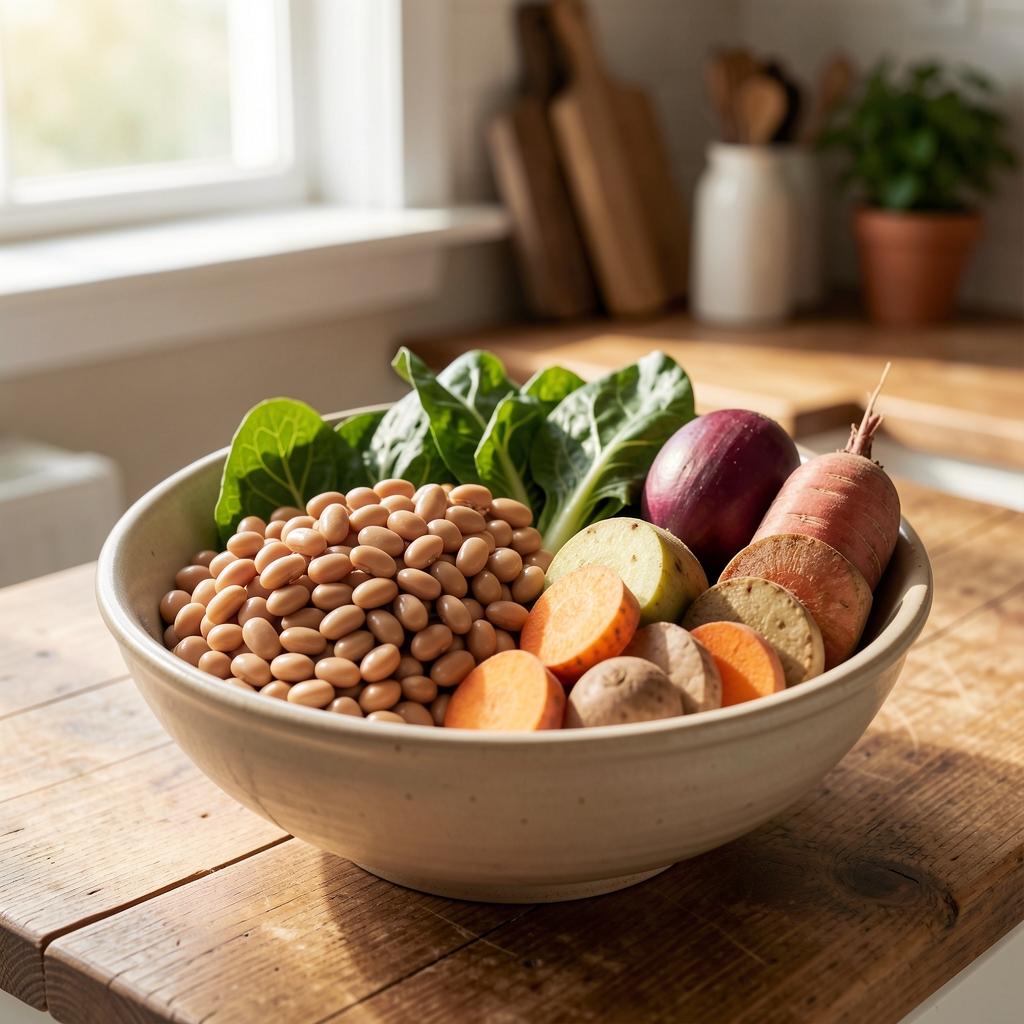
Between November and January, the market stall offered primarily root vegetables: parsnips, celeriac, turnips, swede, three varieties of carrot, and a shifting rotation of brassicas — cavolo nero, purple sprouting broccoli, various cabbages, and Brussels sprouts in their later stages. Citrus was plentiful: Seville oranges in January, blood oranges from late January, navel and clementines throughout. Stored apples and pears through December. Leeks from October forward, reliably, in quantity.
By late February the record shows the first spring arrivals: forced rhubarb from early February (technically a vegetable, kept in the fruit column by habit), purple sprouting broccoli at peak volume, and the first bunches of watercress and land cress. Wild garlic appeared in early March. The transition is not dramatic in any given week, but across the sixteen-week span the weekly record tells a coherent seasonal story that a supermarket basket — unchanging across all four months — does not.
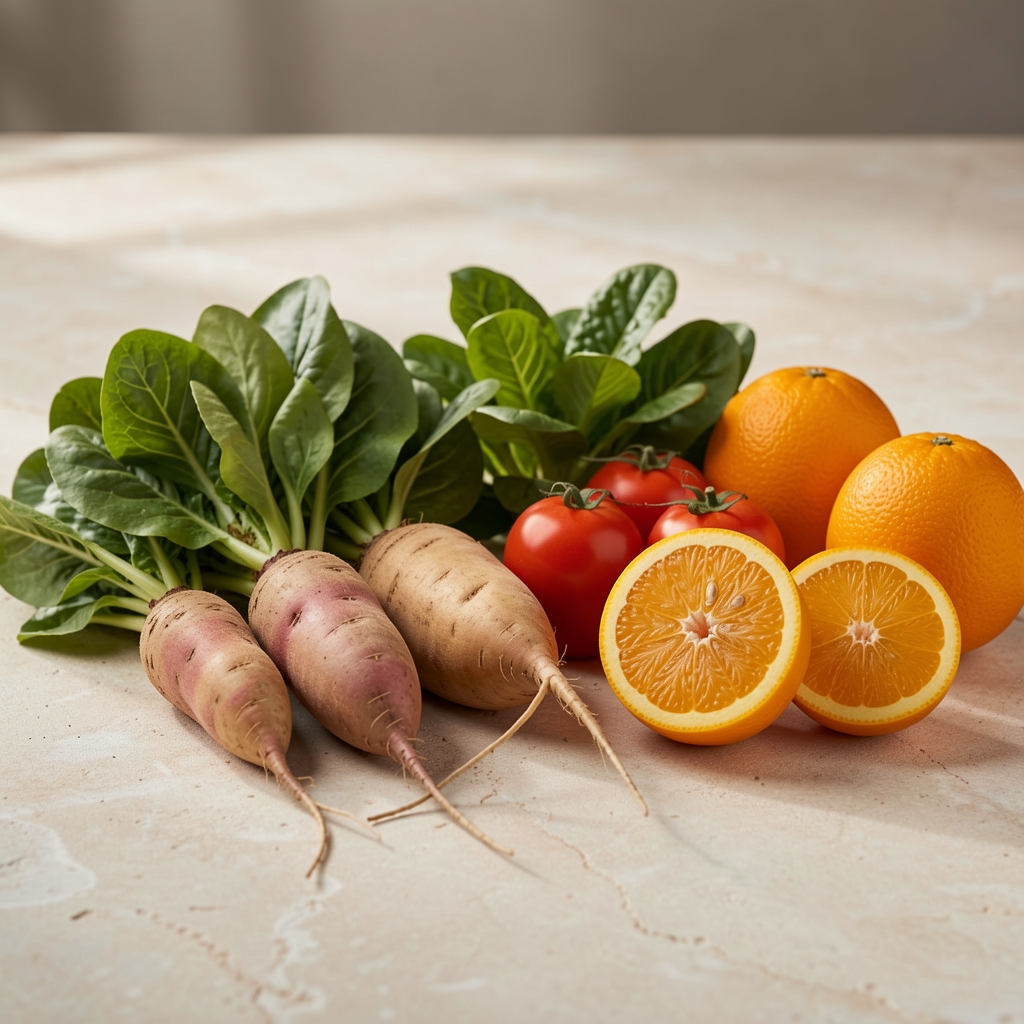
The most immediate observation from comparing the two years of records is a change in dietary variety, as measured by distinct vegetable types consumed per week. In the supermarket-sourced year, the weekly record shows a consistent rotation of roughly five to seven vegetable types across the week, with limited seasonal variation. In the market-sourced year, the weekly count rises to between nine and thirteen distinct types in peak winter weeks, falling only in the brief gap between late root-vegetable abundance and the spring arrivals.
Greater variety in vegetable type translates, in broad nutritional terms, to greater dietary variety across the week. Different vegetables contribute differently to fibre intake, to micronutrient range, to colour variety — which itself broadly signals the presence of different plant compounds. Published nutritional research supports the general principle that dietary variety, particularly in vegetable and fruit intake, is associated with improved nutritional balance. The field notes here add a seasonal dimension: variety in this record is not achieved by buying more of the same things, but by allowing the kitchen to be shaped by what is available at the particular moment in the calendar.
A secondary observation from the record concerns portion behaviour. Certain winter vegetables — roasted celeriac, braised cavolo nero, a pot of leek and potato — produce large-volume, filling meals at relatively modest cost in terms of ingredients. The fibre content is high; the energy density is lower than equivalent protein-heavy or processed-food meals. The satiety effect — the sense of fullness that extends the interval before the next eating episode — is consistent across weeks where root and brassica vegetables featured prominently in the evening meal.
This connects to the portion awareness observations documented in a previous journal entry. Where the meal is high in fibre from whole vegetables, the portion is more likely to be self-limiting: the physical volume and fibre load produce fullness signals before an excessive quantity has been consumed. This is distinct from meals composed primarily of refined carbohydrates or processed foods, where energy density is higher and fullness signals arrive later or less reliably.
The weekly record also captures preparation method. This column is less discussed in standard nutritional analysis, which tends to focus on ingredients rather than process. But across the winter record, a pattern emerges: vegetables prepared by roasting or slow braising featured more frequently in the weeks where the total vegetable portion of the diet was highest, compared to weeks where vegetables were more likely to be steamed or eaten raw. The reason, when examined, is largely practical. Roasted and braised preparations require less immediate attention; a tray of parsnips and celeriac can be put into an oven at 180°C and collected forty minutes later, requiring no further intervention. The lower friction of the preparation method corresponds to a higher frequency of vegetable-centred meals across the week.
This is an observation about cooking and nutrition that published research addresses less directly than the nutritional content of the ingredients themselves: the structural ease of a preparation method shapes how often it gets used, which shapes the overall composition of the weekly diet. A meal that is nutritionally sound but practically demanding is less durable as a weekly habit than one that is nutritionally comparable but structurally simple.
The fruit column of the record showed a different dynamic from the vegetable column. In the market-sourced year, fruit intake by variety was higher in winter — counterintuitively, given that summer is typically associated with fruit abundance. The reason in this specific record is citrus: blood oranges, clementines, navel oranges, and early-season grapefruit from January onward provided a consistent daily fruit component through the darker months when soft fruit (the default summer choice) was absent. Stored apples through December and into January added to this. The discipline of the seasonal constraint — no strawberries in January, no blueberries flown in from Southern Europe — removed the option of defaulting to familiar out-of-season choices and replaced it with what was actually present on the stall.
Vegetables and fruit support nutritional variety in daily diet most effectively when they are genuinely varied, which seasonal sourcing tends to enforce structurally rather than through individual effort. This is the argument the field notes make, modestly: not that one approach to sourcing is categorically superior, but that the relationship between what is available and what is consumed has a structural logic that nutrition advice addressed only at the level of composition tends to miss.
This record is one person's two-year food journal, from one location in London, reviewed by a second editor for descriptive accuracy. It is not a comparative study, does not control for variables beyond produce sourcing, and makes no claims about outcomes that could be extrapolated to broader populations. Content published by Ornev Gazette is selected based on published nutritional research and reviewed for editorial accuracy before publication — and this field note is offered as an observational supplement to that literature, not as evidence in its own right. Readers with specific concerns about their diet are encouraged to speak with a qualified wellness or nutrition professional.

Tobias Ashcroft is a practising nutrition professional and food writer based in London. He contributes seasonal field notes to Ornev Gazette, drawing on two years of weekly produce records maintained alongside his practice observations.
Related: Food Choices & Weight →